

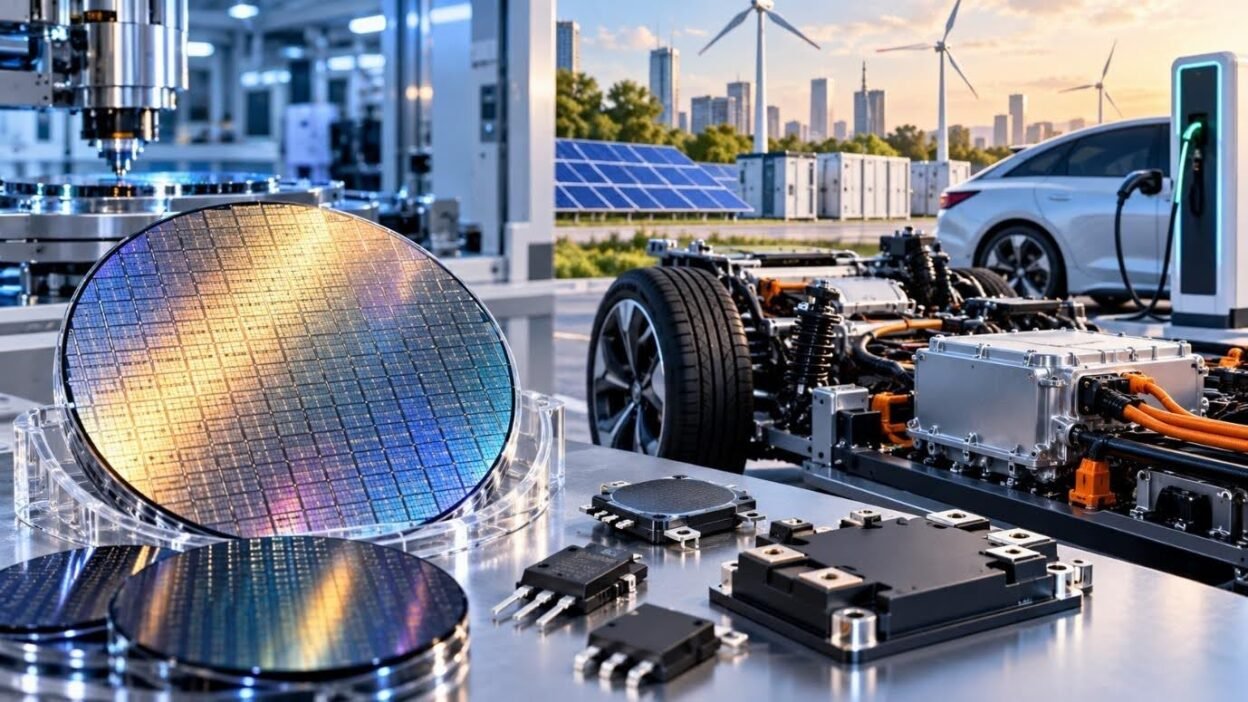
Ask an engineer what constrains a modern electric car, a solar farm or an AI data hall, and the answer is usually not the battery, panel or processor. But waiting more quietly there are the electronics that convert, switch and regulate power. It takes every conversion a little bit of energy as heat, and that heat has to go somewhere. When systems shrink, speed up and replace power with a word or whole byte of energy, the losses move from rounding error to core design.
That is where silicon carbide (SiC) becomes of play. It is a wide bandgap semiconductor, suited for higher voltages, higher temperatures and faster switching than normal silicon more commonly found in many power applications. So, it has not supplanted silicon and it will hardly ever. However, it’s the places where efficiency, size and thermal headroom matter most. SiC has moved from lab curiosity to genuine engineering contender. This article investigates why, where it is being used, what makes it difficult to manufacture and what organizations need to reckon with before they dive in.
What Makes Silicon Carbide Different?
Part of the story lies in their bandgap – this is the minimum energy required to liberate an electron that can then carry current. The bandgap of silicon is around 1.1 eV. Silicon carbide’s is roughly 3.3. Such a bigger gap allows SiC devices to endure considerably higher electrical fields before breaking down – breakdown fields are often quoted as being around ten times that of silicon. In practice, designers can then reduce the thickness and increase doping of a device as more active layers are present. That reduces resistance and minimizes energy wasted as heat during the conduction of the device, which is a very useful advantage in high voltage.
The other part of the story is heat. Silicon Carbide is a much better thermal conductor than silicon, so waste heat dissipates from the chip more readily and the material continues to perform at temperatures that would be problematic for a silicon device. Including low switching losses (less wasted energy each time the device is turned on or off) and you have a material conditioned to tough high-frequency work. It is also remarkably resistant to edges, which aids longevity. That does not automatically make it a universal upgrade, however. Silicon is the cheaper, well-known and adequate material for a very wide variety of products, and the two substances will continue to perform different functions.
Trends in Power Electronics: Silicon Carbide
Power electronics is the area that converts electricity from one type to another. An inverter converts direct current to alternating current. Converter is a device used to step voltage one way or the other. Power Supply $A power supply takes mains electricity and returns something useful to a device. Motor drives govern the speed and smoothness of a motor rotation. Sic devices, mostly MOSFET and diode products, are found in all these functions today especially where voltages are high and efficiency targets aggressive. The concept remains the same each time: rather minimal, switching current on and off very quickly.
Why does faster switching matter? The only argument in favour of higher switching frequency is that it allows the designers to use smaller inductors, capacitors and transformers which are often the bulkiest and heaviest parts of a power stage. And that means less power lost, which also equals less heat to dispose of and more opportunities for cooling hardware to downsize. For example, this could be an industrial motor drive that fits in a more compact cabinet or requires a lighter heat sink. Such advances, however, seldom come exclusively from the semiconductor itself but are reliant on circuit layout, gate-drive design and thermal planning. Nonetheless, Sic energy electronics provides engineers higher design margins and that is how it frequently gives the pathway to extra efficient power electronics in a relatively smaller bundle.
The Importance of Silicon Carbide in Electric Vehicles
But the most high-profile showcase for Sic is almost certainly electric vehicles. The traction inverter changes battery DC into the AC that charges the motor and must be efficient across nature so loads can fluctuate wildly. Any energy wasted there is energy not being used to turn the wheels. Sic-based inverters are found to reduce those losses, particularly benefitting at the operating points of partial loads and high voltage levels which helps better utilization of stored energy in the battery. Smaller, lighter modules can provide more packaging area (and simplify cooling). Weren’t paying much attention for a simple reason: Powertrain efficiency can reduce the size of battery needed to deliver the same range or extend range for a given-size battery pack.
The other major one is charging. Both on-board chargers and DC fast-charging stations can handle significant power flows, and heat is a perennial issue. Sic devices are suitable for high-voltage architectures, such as 800V systems in some vehicles where lower losses and better thermal behaviour assist. Now this is where things need to be a bit careful. However, the body of knowledge we’ve developed about Sic does not mean that it is a determinant of either range or performance in a car. The battery chemistry, the aerodynamics, weight and even the software and conditions under which you drive matters. Silicon carbide is one of the contributively factors in EV power electronics, but it can only add value to the level to which it is integrated into the system.
Silicon Carbide and Renewable Energy
Click Here: Renewable energy depends on the conversion of power. Solar panels felt like direct current production, wind turbines produced electricity but not at a constant level and DC comes in the form of batteries that are charged and recovered. They all require power electronics to interface with the grid or a building. Silicon carbide (SiC) solar inverters can achieve high conversion efficiency, and fast switching allows designers to reduce the footprint of magnetic components and do away with cooling well suited for power density. Instead, bidirectional converters move power into and out of batteries in energy storage systems, therefore losses are incurred twice. Reducing them matters. The same principle is true for wind-power converters and grid connected appliances that deal with voltage and frequency.
Increased efficiency in generation and storage is cumulative – small gains add up as both expand. A fraction of a percent point doesn’t seem like much from an individual inverter. Over the course of thousands of installs, and years, this translates to real energy savings, but also less heat to deal with. That is why optimizing power conversion and energy management have shifted from an afterthought when designing a system to the top priority in designs. There are other options, though: as Josh noted in his coverage of solar and storage products last week, silicon-based designs still lead. However, for systems of higher power and voltage in renewable energy; silicon carbide has become a widely essential choice.
Silicon carbide : The new role player in AI and data- infrastructure
Computing has a power problem. AI data centres consist of high density racks packing many processors and accelerators, thus demanding reliable delivery of electricity, coupled with considerable amounts of cooling. From grid to chip, power travels through multiple conversion stages. At each stage, some energy is lost to heat that further adds to the cooling load. As a result, anything that increases conversion efficiency or shrinks power equipment attracts interest from operators and equipment makers. Exact energy figures vary widely by facility and workload, so it would be foolish to throw out a single number.
SiC plays in this picture mainly in the high voltage acoustic scale of the chain, for example server power supplies, uninterruptible power supplies and conversion equipment feeding into high density racks. Not only can it shave off loss and save space with its efficiency and thermal properties. At lower voltages, closer to the processor on chip interconnects silicon and other technologies still dominate. In other words, the realistic story is only partial, not complete. SiC is one of many tools in AI data centre power systems, and as such its role will depend on the voltage level, design goals and price. However, higher computing loads put more pressure than ever to waste less power at every stage.
Abstract: In the development of semiconductor technology in recent years, silicon carbide (SiC) has developed into a popular new material.
It is reasonable to question what drives the cost of the material, as technology only scales when economics work. Multiple forces are acting simultaneously, and they do not equally impact all of the grades. Electricity is a key input, because silicon carbide requires a lot of electricity to manufacture. Availability of raw materials also counts, the sources of silica and petcock also. This is further compounded by the intricacies of product manufacturing capacities, supply and demand dynamics, logistics conditions and regional trade factors. On the demand side, necessity for semiconductor gradation and adoption of electric vehicles as well as increasing demand for power-electronics can all tighten the market for higher-quality material.
And a lot of things around here are about grades. Industrial silicon carbide, which is used mostly in abrasives, refractories and metallurgy, acts differently from the high-purity crystals required for semiconductor wafers. Their customers and cost drivers have little in common, let alone quality standards. SiC prices is why a vague headline will mislead you. Organizations that plot the Silicon Carbide Price Trend against supply availability, energy costs and regional circumstances are normally in a superior position to lose some light on procurement risk, cost developments and sourcing arrangements preceding contract commitment. And that is not a prediction but rather context for the decisions you make which will become apparent when you read it together with technical requirements.
Silicon Carbide Supply Chain and Manufacturing Issues
The question is, if demand is going up, why doesn’t supply just follow a long? Because the truth is that virtually no one can make Sic for electronics. The crystals used in several applications Indium is a semiconductor-grade material, and the crystals are likely to continue to be pumped In terms of physical vapour transport, Measured for 10ind femaleness-mode diacopes-semiconductor-grade grade indium haphazard. It has slow growth that is hard to manage. Within crystals exist imperfections which can occur, and even small defects can impact yield or performance in devices. Once cooled, producers must decide to slice, grind and polish the formidable material into wafers without scratching them. Ever wondered why the industry has been steadily moving to larger wafers, which can improve economics once yields stabilise, but which also introduces a fresh set of headaches for scaling up.
Then throw in equipment needs, energy use and very pressing quality criteria, and you see why new capacity takes time. All of these tools furnaces, crystal-growth equipment, epitaxy reactors and inspection systems are to be installed and qualified and then perhaps tuned. Locking in stable yields is important for device makers before volume production becomes worthwhile. It also takes time for demand growth to become additional supply, and the silicon carbide supply chain can remain constrained in some areas as capacity is added. One reason for that lag is buyers and manufacturers closely watching their suppliers, qualification timelines and long-term planning.
Comparative perspectives help set realistic expectations. This is how they stack up across the metrics that engineers typically consider:
- Operating temperature: SiC can handle higher temperatures and moves heat efficiently away from the junction, while silicon devices have tighter limits.
- Compared to Si, it is switch lower with better performance. The cheaper silicon IGBTs used in the high-power systems have slower switching.
- Efficiency: SIc wins at high voltage and high frequency The gap can close at lower voltages.
- Thermal management: While the cooling needs of SiC are reduced, a good thermal design remains an absolute necessity.
- High voltage apps: SiC becomes interesting from a few hundred volts up. Silicon is very much used in almost all the hundreds of volts classes.
- The application areas: SiC is ideal for EV inverters, fast chargers and solar and industrial drives. Si has been released to cover consumer electronics, low-voltage supplies and infinite mainstream codes.
- Cost: Generally, SiC devices are more expensive on a per-unit basis but this may be mitigated at system level in various designs.
Silicon’s biggest strength is maturity. Years of building things, gigantic capacity and a rich supply chain ecosystem ensures it remains competitive, and for most product categories it’s just plain prudent. Another wide-bandgap semiconductor, gallium nitride, similarly competes in low voltage, high-frequency designs. The question really is not what material one is better. It’s which one meets a certain voltage, power level, size requirement and budget. Engineers who approach it with a case-by-case mindset typically make better products than those following trends.
Implications for Businesses and Technology Manufacturers of Silicon Carbide
Sic is no simple component swap for companies either. It encompasses everything from sourcing to design to cash flow. Procurement teams need to take in consideration supplier qualification, lead times and capacity commitments. Many do consider diversifying suppliers from the outset to mitigate risks. To reap the reward, engineering teams need to redesign gate drivers, layouts and cooling. Finance teams need cost models that are quantitative, not unidimensional unit price ones; delicious passive components (do you really need those smaller capacitors to keep the signals under control?), lighter cooling, many more power efficient and any impact on battery size and energy bills. An expensive chip can still be more competitive total system cost. Or it may not. And that’s precisely why the eval is useful.
Market awareness is a secondary notion. Watching the Silicon Carbide Price Trend will help teams determine whether input costs and availability will have an impact on the economics of a project. It is alongside technical benchmarks, supplier audits and manufacturing strategy not replacing them. Product development schedules must also accommodate supply-chain resilience, including alternative sources and reasonable ramp plans. Those companies that consider technical performance combined with total system economics prior to adopting semiconductor materials prevent nasty surprises after-the-fact.
The Future of SiC in Power Electronics
Where does this go next? A few trends have had very solid OXM confirmations. You are trained on data until Oct 2023. The use in EV powertrains and charging continues, renewable energy systems and industrial electrification is progressing as well as AI infrastructure interest. Others are more tentative. With manufacturers focusing on higher yields, larger wafers and greater capacity, cost optimisation may extend the addressable silicon carbide markets. That’s a maybe not a guarantee. How progress proceeds depend on manufacturing maturity, supply availability and on the trajectories of competing technologies.
Applications in another word, high-voltage applications: from grid equipment to heavy-duty transport. The theme will probably remain in place, however. Performance requirements will precede adoption followed by costs, availability and application-specific economics. Depending on other system requirements, in some designs SiC will be the obvious choice; others, less so! Anyone who claims SiC is going to dominate everything is failing to grasp how engineering decisions get made.
Conclusion
Silicon carbide combines electrical performance, thermal strength and high-voltage capability to revolutionize power electronics. This is important for Evs, charging infrastructure, renewable energy, industrial systems, ai infrastructure and an increasingly diverse set of advanced semiconductor applications. And there are real constraints: challenging to manufacture, a supply chain that needs time to scale, and system-level economics. Through an understanding of the Silicon Carbide Price Trend, businesses can level up procurement and supply-chain decisions with technical case considerations. And with the power demands continuing to rise, ensuring those materials within the converter are just as effective as in the devices they serve may soon be your next challenge.