
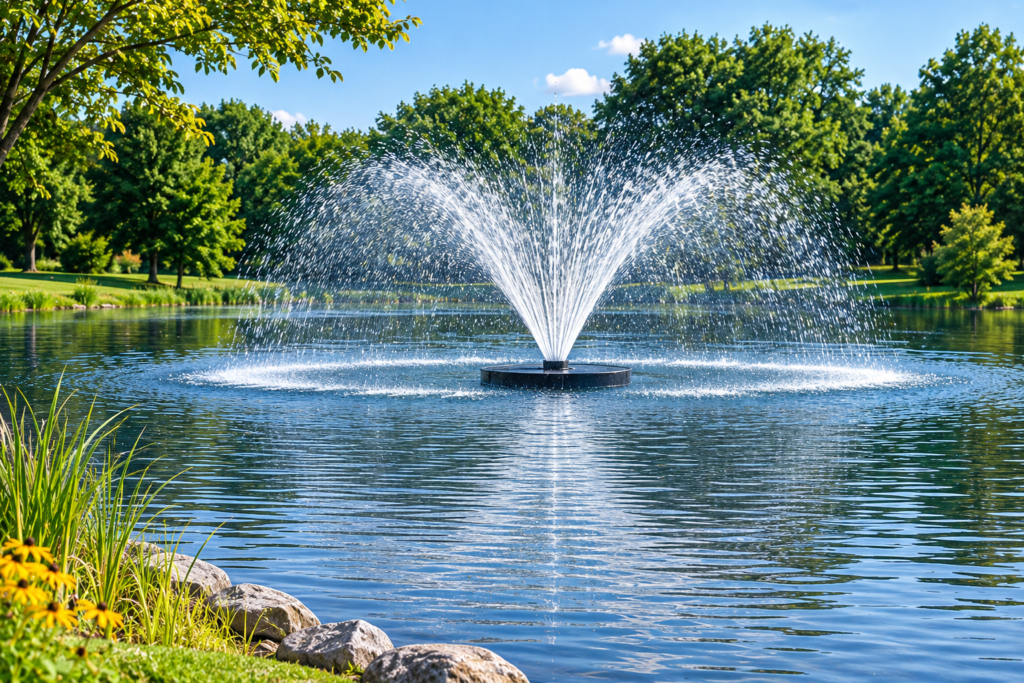
Large ponds can benefit from water movement for both visual and practical reasons. A floating fountain can create a visible spray pattern while circulating and aerating water across the pond surface. Floating fountains for large ponds are designed to combine water movement with an attractive surface display. Selecting the right system requires attention to pond size, water depth, pump capacity, electrical requirements, spray characteristics, and maintenance needs rather than focusing only on appearance.
Why Use Floating Fountains for Large Ponds?
A floating system can be positioned directly on the water and anchored so that it remains within the desired area. Water circulation can help reduce stagnant conditions and distribute oxygen throughout the water. This can be particularly useful in ponds containing aquatic life, although the appropriate fountain size depends on the characteristics of the pond.
The fountain should be selected according to the pond’s dimensions and the desired level of circulation rather than simply choosing the largest available motor.
Understanding Horsepower and Flow Rate
Friendly Fountains currently lists floating pond fountain systems in three primary motor sizes: 1/3 HP with 4,000 gallons per hour, 1/2 HP with 5,300 GPH, and 3/4 HP with 6,600 GPH.
The 3/4 HP option is specifically described as delivering 6,600 GPH and being intended for medium to large ponds.
Flow rate provides an indication of how much water the pump can move, but it should not be treated as the only measurement when sizing a fountain. Pond surface area, depth, shape, water conditions, desired spray height, and available electrical service can all influence the appropriate system.
Water Depth and Placement
Water depth is an important installation factor. For example, the 1/3 HP model listed by Friendly Fountains requires a minimum water depth of 36 inches.
The fountain needs enough space beneath the floating unit for the pump to operate correctly without drawing in excessive debris or becoming obstructed by the pond floor.
Positioning also affects the appearance of the spray. A fountain placed too close to an edge may send water toward surrounding landscaping, while positioning it near the centre can provide a more balanced display in many ponds.
Spray Patterns
One advantage of floating fountain systems is the ability to change spray patterns. The listed 1/3 HP system includes five interchangeable nozzles, including Tulip, Gusher, Classic V, Wide V, and Trumpet patterns.
Different patterns produce different spray heights and widths. A wide pattern may be suitable for a broad pond surface, while a taller and narrower display may be better suited to a particular visual focal point.
The correct nozzle therefore depends on both the pond’s dimensions and the desired visual effect.
Lighted Floating Fountains
For ponds used during the evening, a lighted floating fountain can combine water movement with illumination. Choosing floating fountains for large ponds requires consideration of pond dimensions, water depth, pump capacity, spray pattern, electrical requirements, and maintenance.
The light systems are available in white or colour-changing configurations, depending on the model. Lighting can make spray patterns easier to see after sunset and can create reflections across the water.
When installing a lighted system, electrical safety is especially important. The equipment should be installed and operated according to its electrical specifications and applicable safety requirements.
Installation and Anchoring
Floating fountains generally require positioning, anchoring, and electrical connection. The 1/3 HP model’s installation instructions specify assembling the pump and float, placing the fountain in at least 36 inches of water, attaching the mooring rope directly to the pump, and connecting it to a 110/120V GFCI-protected outlet.
Maintenance Requirements
Routine maintenance helps preserve fountain performance. Debris can obstruct pumps or nozzles, reducing water flow and affecting spray quality.
Friendly Fountains recommends periodic debris-bag cleaning, nozzle checks, and seasonal inspections. In freezing climates, seasonal removal is recommended to prevent equipment damage.
Regular inspections are particularly useful for larger ponds because accessing equipment can become more difficult once problems develop.
Conclusion
Available systems range from 4,000 GPH to 6,600 GPH, with lighted versions providing additional nighttime illumination. The right outdoor fountain base and anchoring arrangement are equally important because a floating system must remain correctly positioned during operation. A properly sized fountain can provide consistent water movement and a defined visual feature while supporting the practical needs of a pond environment.