

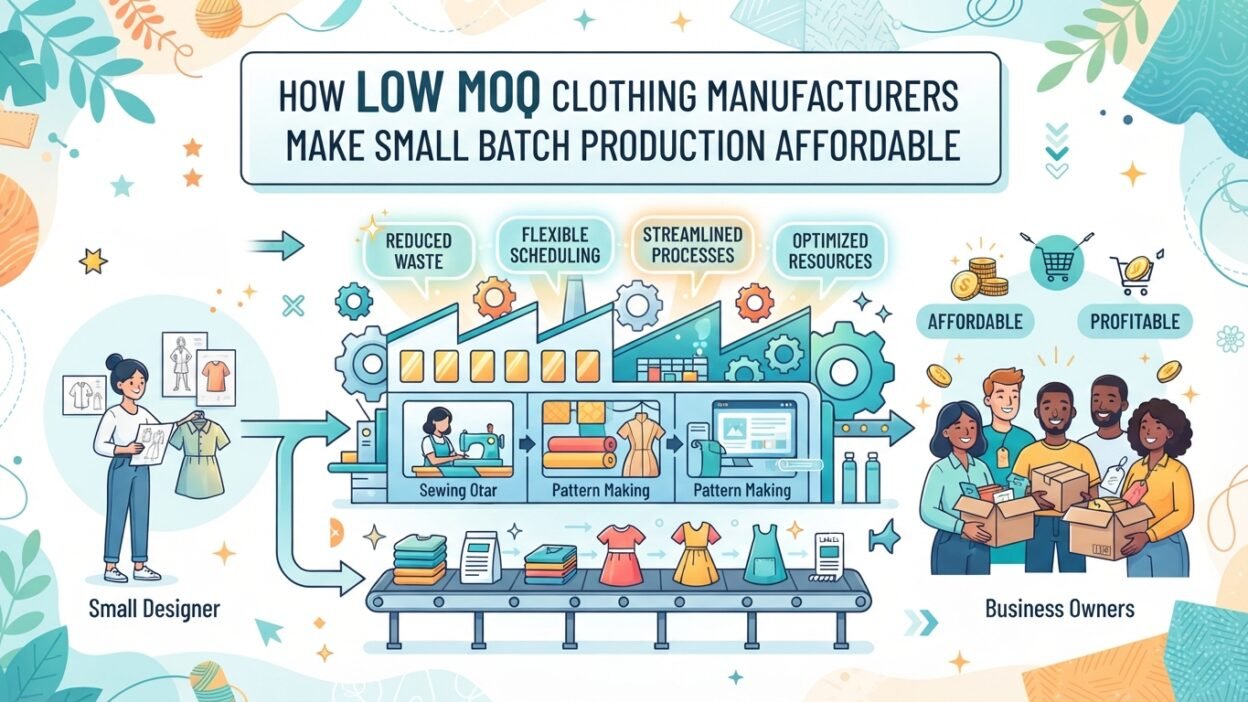
Launching a clothing brand has never been more accessible, but turning creative ideas into profitable products still comes with significant challenges. One of the biggest hurdles for startups and growing fashion businesses is meeting the high minimum order quantities (MOQs) often required by manufacturers. Large production runs demand substantial upfront investment, increase inventory risks, and leave little room for experimentation. Fortunately, the rise of low MOQ manufacturing has transformed the apparel industry by making small batch production practical, affordable, and scalable.
Small batch production enables brands to manufacture limited quantities without compromising on quality. Instead of committing thousands of units to a single design, businesses can produce only what they need, gather customer feedback, and make improvements before investing in larger orders. This approach significantly reduces financial risk while encouraging innovation and faster product development.
Whether you’re launching your first collection, expanding an existing apparel line, or creating custom merchandise for a niche audience, working with experienced manufacturing partners that offer low minimum order quantities provides the flexibility modern brands need. From sampling new concepts to responding quickly to fashion trends, low MOQ production has become a strategic advantage for businesses of every size.
Understanding Low MOQ Manufacturing
MOQ stands for Minimum Order Quantity, referring to the smallest number of units a manufacturer requires before beginning production. Traditional factories often establish high MOQs because larger production runs maximize efficiency and reduce per-unit manufacturing costs.
Low MOQ manufacturers, however, have adapted their production systems to accommodate smaller businesses by offering significantly reduced order requirements. This flexibility enables startups, independent designers, e-commerce sellers, and boutique brands to enter the market without excessive financial commitments.
Instead of viewing smaller orders as inefficient, modern manufacturers streamline production processes, optimize sourcing, and implement flexible workflows that make limited production economically viable for both parties.
Why Small Batch Production Is Growing in Popularity
Consumer preferences have changed dramatically over the past decade. Today’s shoppers increasingly value exclusive collections, sustainable production, and unique designs rather than mass-produced garments.
As a result, many fashion businesses intentionally produce smaller collections that emphasize quality and originality over volume.
- Reduced inventory costs
- Lower financial risk
- Faster product launches
- Better inventory management
- Ability to test new collections
- Greater product exclusivity
- Improved sustainability
- Higher design flexibility
Small batch production also allows brands to react quickly to seasonal trends instead of holding unsold inventory that eventually requires heavy discounts.
How Low MOQ Manufacturers Reduce Production Costs
Many entrepreneurs mistakenly assume that smaller orders automatically mean significantly higher expenses. While unit costs may increase slightly, the overall investment is often considerably lower because businesses avoid purchasing thousands of products they may never sell.
Modern manufacturers reduce costs through several operational improvements:
- Optimized cutting layouts that minimize fabric waste.
- Flexible production scheduling.
- Digital pattern-making technology.
- Efficient inventory planning.
- Multi-product production lines.
- Better supplier relationships for raw materials.
These efficiencies enable manufacturers to remain profitable while offering affordable production options for smaller brands.
Lower Financial Risk for Emerging Fashion Brands
Every apparel business faces uncertainty when introducing a new design. Customer preferences evolve quickly, making it difficult to predict which products will become bestsellers.
Rather than investing heavily in thousands of garments, businesses can start with smaller production runs, measure demand, and reorder successful products while discontinuing underperforming styles.
This strategy improves cash flow and minimizes the financial burden of carrying unsold inventory.
For lifestyle brands expanding into complementary accessories, sourcing wholesale canvas cross body bags allows companies to diversify their product offerings without making excessive inventory commitments, creating additional revenue opportunities while maintaining manageable stock levels.
Improving Product Quality Through Continuous Testing
Low MOQ production creates opportunities for continuous product refinement. Instead of manufacturing large quantities immediately, brands can produce smaller batches, gather customer reviews, and implement improvements before scaling production.
This iterative process helps businesses improve:
- Fabric selection
- Garment fit
- Sizing accuracy
- Color consistency
- Print durability
- Trim placement
- Packaging quality
Customer feedback becomes significantly more valuable when brands have the flexibility to make adjustments between production runs.
Faster Response to Fashion Trends
The fashion industry moves rapidly. Trends often emerge and disappear within months, making speed a competitive advantage.
Low MOQ manufacturers help brands respond quickly by reducing production commitments and enabling shorter development cycles. Instead of waiting until an entire warehouse sells out, businesses can introduce fresh collections more frequently.
This agility is especially valuable for online retailers that rely on social media marketing and influencer campaigns to generate demand.
Supporting Sustainable Fashion Practices
Overproduction remains one of the apparel industry’s biggest environmental challenges. Excess inventory often ends up discounted, destroyed, or sent to landfills.
Small batch manufacturing supports sustainability by producing closer to actual consumer demand. Brands purchase only what they need, reducing textile waste, storage requirements, and unnecessary resource consumption.
Consumers increasingly reward businesses that demonstrate responsible manufacturing practices, making sustainability both an ethical and commercial advantage.
Expanding Beyond Apparel
Successful fashion brands rarely rely solely on clothing. Accessories create additional revenue streams while strengthening brand recognition and increasing average order values.
Adding premium accessories alongside apparel allows businesses to create complete lifestyle collections that appeal to a broader customer base.
Offering custom tote bags wholesale provides fashion brands with versatile products that complement seasonal apparel collections while serving as practical, everyday promotional items that customers continue using long after purchase.
Production Comparison: Traditional vs Low MOQ Manufacturing
| Factor | Traditional Manufacturing | Low MOQ Manufacturing |
|---|---|---|
| Minimum Order | High volume | Small batches |
| Investment | Large upfront cost | Lower initial investment |
| Inventory Risk | High | Low |
| Product Testing | Limited flexibility | Easy to test new ideas |
| Customization | Often restricted | Highly flexible |
| Scalability | Requires larger commitments | Scales gradually with demand |
Choosing the Right Manufacturing Partner
Not every manufacturer offering small order quantities provides the same level of service. Selecting the right partner requires careful evaluation beyond pricing alone.
Look for manufacturers that demonstrate:
- Consistent quality control
- Transparent communication
- Flexible customization options
- Reliable lead times
- Ethical manufacturing practices
- Material sourcing expertise
- Product development support
Working with experienced suppliers of custom laptop bags wholesale also enables fashion brands to expand into professional accessories, offering customers functional products that complement modern work and travel lifestyles.
Scaling Your Brand Without Overcommitting
Growth doesn’t always require massive production runs. Many successful apparel companies scale gradually by increasing production only after confirming market demand.
This measured approach preserves working capital while reducing operational stress. Instead of financing excess inventory, businesses can invest more resources into marketing, customer service, product development, and brand building.
Partnering with an experienced low MOQ clothing manufacturer gives brands the flexibility to launch collections confidently, refine products through customer insights, and increase production strategically as demand continues to grow.
Step-by-Step Guide to Successful Small Batch Production
- Define your target audience and product goals.
- Create detailed tech packs with measurements and material specifications.
- Order prototypes and evaluate quality carefully.
- Launch a small production run.
- Collect customer feedback and sales data.
- Refine designs based on real-world performance.
- Scale successful products with repeat orders.
Frequently Asked Questions (FAQs)
What is considered a low MOQ?
A low MOQ varies by manufacturer but generally refers to production quantities significantly lower than traditional factory requirements, making manufacturing accessible for startups and smaller brands.
Is small batch production more expensive?
Although the cost per unit may be slightly higher, the total investment is usually much lower because businesses purchase fewer products and reduce inventory risks.
Can low MOQ manufacturers maintain high quality?
Yes. Reputable manufacturers follow established quality control procedures regardless of order size, ensuring products meet professional standards.
Who benefits most from low MOQ manufacturing?
Independent designers, startup clothing brands, online retailers, boutique stores, corporate merchandise providers, and businesses testing new product ideas benefit greatly from low MOQ production.
Build Your Brand with Flexible Manufacturing Solutions
Affordable small batch production has changed the way modern fashion brands enter and grow within competitive markets. By reducing financial barriers, supporting continuous product improvement, and enabling rapid responses to changing consumer trends, low MOQ manufacturing empowers businesses to innovate with confidence. Whether you’re launching your first apparel collection or expanding into premium accessories, choosing the right manufacturing partner lays the foundation for sustainable growth and long-term success. Start building smarter, produce responsibly, and position your brand for scalable success with manufacturing solutions designed around flexibility and quality.