
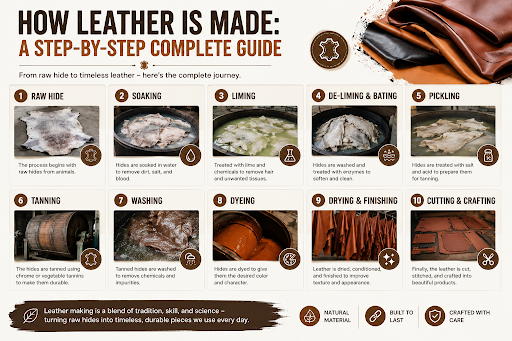
Ever wondered how a raw animal hide transforms into the smooth, supple leather in your favorite jacket or bag? The process is part science, part art, and it hasn’t changed all that much in centuries. But what has evolved is the accuracy, the technology, and the quality of the workmanship brands now give at every step.
Whether you’re a curious buyer or just someone who wants to know what you’re really paying for, here is the complete breakdown of leather from hide to final product.
Step 1: Sourcing the Hide
All leather is made from a raw animal hide, most often cow, but goat, sheep, and pig are also common. The hide is a by-product of the meat industry, and as such, it is closely coupled to the food supply chain, instead of being an independent sector.
There is already a divergence in quality at this stage. Premium hides are from animals that are raised under “controlled” conditions, with no scarring, insect bites, or branding marks on them. Avoidable hide defects are sent to lower-grade leathers that usually have lower value.
Step 2: Preservation (Curing)
Raw hides deteriorate quickly and so must be preserved immediately after collection. This is usually accomplished via:
- Salting — packing the hide in salt to draw out moisture
- Drying — air-drying in a controlled environment
- Chilling — refrigeration for short-term preservation before processing
This step ensures the hide stays stable during transport to the tannery, where the real transformation begins.
Step 3: Soaking and Cleaning
Hides are arranged in large drums at the tannery, where they are soaked in water to rehydrate them and wash away salt, dirt, and remaining blood and debris. It may take several hours to a few days depending on the method of preservation of the hide.
Step 4: Removing Hair and Flesh (Liming)
The hide is treated with a lime solution to loosen out hair, fat, and any remaining flesh. Then the workers employ special machines that peel the hides on both sides: hair off and flesh off. The rest is a raw and workable material known as the “pelt”.
Step 5: Tanning — The Most Important Step
The process of tanning makes a perishable hide into a durable and long-lasting leather. If not, it would only rot away. There are two main ways:
Vegetable Tanning:
Uses plant and tree bark to act as a natural tanning agent. A traditional way of producing leather which takes weeks but results in rich and authentic leather, giving a beautiful patina over the years. This is the preferred way of making high-quality, premium leather products.
Chrome Tanning:
Uses chromium salts and only takes a day or two. It’s quicker, cheaper, and yields more pliable, flexible leather than vegetable tanned leather, yet it doesn’t offer the natural leather “flesh tone” and “grain pattern” of vegetable tanned leather.
Some of the most sought-after leather — including certain Alaskan leather jackets — relies on slower, more traditional tanning methods to withstand extreme cold and rugged use. This kind of leather is built specifically to handle harsh climates without losing flexibility or strength, which is exactly why it holds up so well over decades of wear.
Step 6: Splitting and Shaving
After it has been tanned, the hide is split into layers. The top layer (full-grain) is the strongest and most valuable; the lower layers (used for genuine or split leather) are thinner and less sturdy. Each layer is then shaved to a consistent thickness.
Step 7: Dyeing and Coloring
Depending on the finish, leather is dyed with drums, sprays or hand application. Aniline dyes are absorbed into the leather, providing the natural appearance, while pigmented finishes are applied to the surface, offering a more even and protective finish.
Skilled colorists carefully match tones, especially for brands that need consistency across large custom production runs.
Step 8: Drying and Conditioning
After dyeing, the leather is dried using techniques like:
- Vacuum drying — removes moisture quickly under pressure
- Toggle drying — stretches the hide on frames to dry evenly
- Air drying — a slower, more traditional approach
Once dry, the leather is conditioned with oils and fats to restore flexibility and softness, preventing it from becoming stiff or brittle.
Step 9: Finishing Touches
This final stage determines the leather’s surface texture and appearance:
- Buffing and polishing for a smooth, refined finish
- Embossing to add texture or pattern
- Waxing or oiling for extra water resistance and shine
- Quality inspection to catch any flaws before the leather moves to production
This is also where trusted manufacturers separate themselves — rigorous inspection at this stage ensures only the best material makes it into the final product.
Step 10: Cutting and Crafting the Final Product
Once finished, the leather is cut into patterns and stitched into the final item — whether that’s a wallet, jacket, or bag. Here, expert designers and precision stitching are key to durability and fit.
If you are interested in having high-quality leather backpacks made from top-quality hides, and you would like the entire process, from sourcing the leather to stitching the final product — to be transparent and of the highest quality, you may want to consider a premium leather backpack USA. Sometimes the skilled artisanal hand that is involved in every aspect of the process, more stringent quality control, and materials that are produced to high-quality standards make the difference in the making of a bag that is truly made in the USA.
Why Does This Process Matters to You as a Buyer?
It is important to understand leather’s manufacture to understand why the price of leathers can range so extensively from product to product. A leather bag that is full-grain, vegetable-tanned will require more time, skill, and raw material than a chrome-tanned leather bag would and it will last longer.
The next time you’re buying leather accessories, you’ll know exactly what you are getting and why it’s worth it!
Final Thoughts
Leather manufacture is a manual process that combines old and new, from raw hide to the finished product. Each step in the leather’s sourcing, tanning, dyeing, and finishing process contributes to the final quality, durability, and character of the leather you end up with.
When you are buying a jacket, wallet, or bag, you can be sure that you are getting leather you know will really last you a long time, and not just until the time you need to throw it in the trash.