

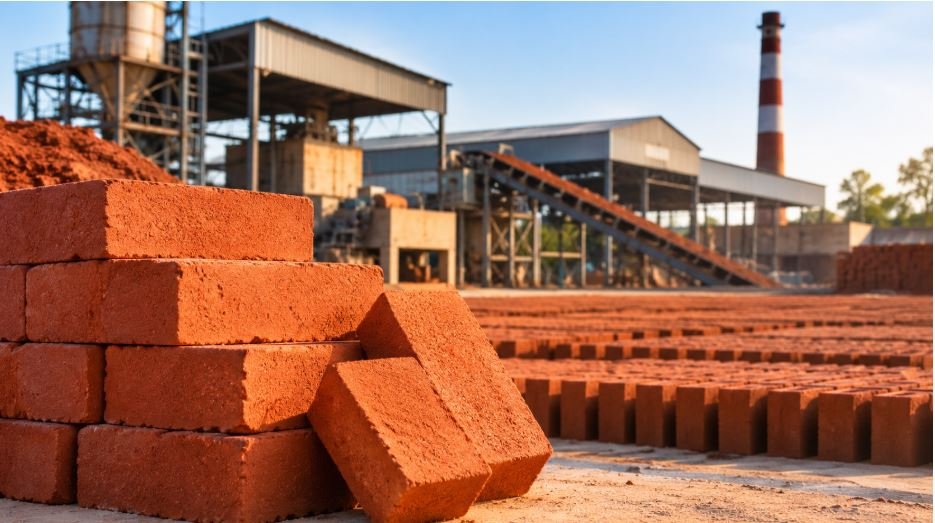
Most people see a brick only when it arrives on a construction site, stacked neatly on a truck. Few think about the journey it takes before reaching them. Behind every good brick is a carefully managed process that turns ordinary soil into a strong, durable building block. Understanding this process helps builders, contractors and homeowners judge quality and choose better suppliers.
In this article, we take you inside a modern brick plant and walk through each stage of production.
Stage 1: Selecting and Preparing the Clay
Everything starts with the raw material. Good bricks need clay with the right balance of alumina, silica, lime and iron oxide. Too much lime can cause the brick to crack after firing, while too little silica makes it brittle.
In a well-run brick manufacturing plant, clay is first dug and left to weather for some time. Weathering softens the clay and helps remove unwanted salts. The clay is then cleaned of stones, roots and other impurities. After that, it is mixed with water and sometimes with additives such as sand or fly ash to improve workability and strength.
Stage 2: Tempering and Mixing
Tempering is the process of kneading the clay until it reaches a uniform, plastic consistency. In older setups this was done by hand or with animals. Modern units use pug mills and mixers that blend the clay thoroughly and remove air pockets. Uniform tempering is essential because air bubbles and uneven moisture lead to weak spots and cracks later.
Stage 3: Moulding
Once the clay is ready, it is shaped into bricks. There are two broad methods:
- Hand moulding: Workers press clay into wooden or steel moulds. This is common in traditional units but produces bricks with varying size and finish.
- Machine moulding: Extrusion or press machines force clay through a die or into moulds under high pressure. The bricks come out dense, uniform and with sharp edges.
Machine moulding has become the preferred choice for producers who focus on consistent quality and large volumes.
Stage 4: Drying
Freshly moulded bricks contain a lot of moisture. If they go straight into the kiln, the water turns to steam and cracks the brick. So the bricks are dried first, either naturally in open yards or in covered drying sheds.
Drying must be slow and even. Bricks are stacked with gaps for air circulation and turned when needed. Depending on the weather, this stage can take from a few days to a couple of weeks. Covered drying protects bricks from sudden rain and keeps production going during wet months.
Stage 5: Firing in the Kiln
Firing is the heart of the process. Dried bricks are loaded into a kiln and heated gradually to around 900 to 1,100 degrees Celsius. At these temperatures, the clay particles fuse together and the brick gains its strength and hardness.
Modern plants use efficient kilns such as zig-zag or tunnel kilns. These designs distribute heat more evenly, use less fuel and produce fewer emissions than old clamp methods. Even firing means fewer under-burnt (soft) or over-burnt (distorted) bricks in each batch.
A well-managed brick factory monitors kiln temperature closely, because firing quality directly decides the brick’s compressive strength and water absorption.
Stage 6: Cooling and Sorting
After firing, the bricks are allowed to cool slowly. Rapid cooling can create internal stress and hairline cracks. Once cool, the bricks are sorted by quality. First-class bricks have uniform colour, sharp edges and a clear ringing sound when struck. Lower grades are separated for less demanding uses.
Stage 7: Quality Testing
Responsible producers test samples from every batch. Common tests include:
- Compressive strength test to check load-bearing capacity
- Water absorption test to measure how much water the brick soaks up
- Efflorescence test to check for soluble salts
- Dimension check to confirm size tolerance
These tests ensure that the bricks meet standards such as IS 1077 and perform well on site.
Stage 8: Storage and Dispatch
Finished bricks are stacked in a clean yard and dispatched to customers. Plants with their own fleet of trucks can deliver quickly and handle bulk orders without delays.
Why This Matters to Buyers
Every stage in this process affects the final product. Poor clay selection, rushed drying or uneven firing all lead to weaker bricks. When you buy from a plant that controls each step carefully, you get bricks that are stronger, more uniform and longer lasting.
If possible, visit the plant before placing a large order. Look at the clay preparation, the moulding machines, the kiln and the sorting area. A clean, organised facility usually reflects a team that takes quality seriously.
Conclusion
A brick may look simple, but making a good one requires skill, technology and discipline. From weathering the clay to testing the final batch, each step shapes the strength and life of the walls you build. Knowing how bricks are made puts you in a stronger position to choose the right supplier and build with confidence.