

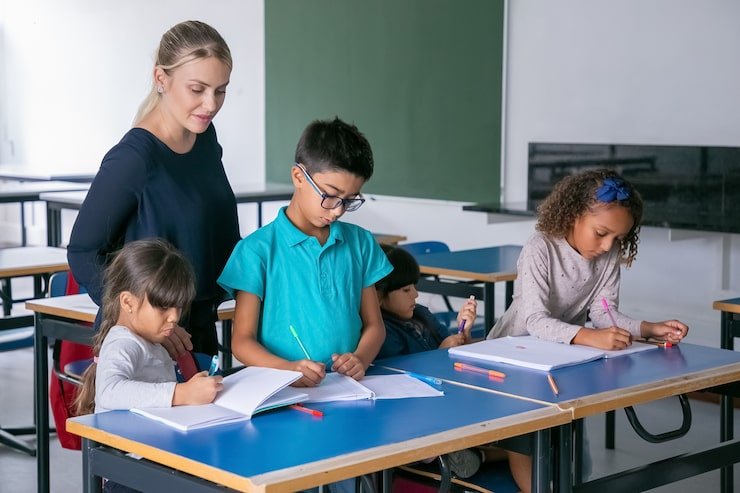
The educational curriculum of the elementary years should give children an opportunity to discover their abilities besides learning academic subjects. Reading, writing, math, and science are some of the fundamentals, but creativity is another important component when it comes to the children’s perception of the world around them. Artwork, painting, storytelling, music activities, making crafts, and imagination are just different means for the expression of the child’s thoughts.
Such a mode of learning may help the development of the skills of observing, exploring, trying new things, and learning about their interests. The process of creative learning provides an opportunity for those children who can easily express themselves through paintings, movements, and actions but not words. This will make the process of learning entertaining and diverse for children. It will also help in the creation of a well-balanced environment where both academic success and the interests of the children receive equal attention.
Creativity as a Basic Aspect of Children’s Development
When drawing, creating something from materials with their hands, or telling stories, children interpret events and impressions of real life. Creativity is the process that allows developing the mentioned interests in an organized and appropriate manner. Craft activities allow experimenting with shapes and materials by means of personal experience. The process of planning, changes, and accomplishment of an idea and experiment is as significant as the results themselves. Teachers can help in this process by giving different materials and letting children work according to their interests. In other words, there is a possibility to realize the interests of children without the necessity of achieving the desired results in creative works.
The Function of Art in Helping Students Observe and Communicate Better
Through art, students are able to express themselves using tools of communication that are at their disposal since they are not able to communicate in words. Colors, forms, lines, and images can communicate experiences, emotions, observations, and memories of a child. While drawing or painting, children make certain decisions on how to organize the elements and what materials to use. Art can be integrated into the classroom subjects and therefore make art learning much more interesting. For example, drawing plants will assist children in learning science subjects, and illustrating stories will help them comprehend the plot and characters better. In this way, children will be able to learn something new from a different angle. Students must be encouraged to experiment with their creativity rather than comparing themselves with other children.
The Role of Storytelling in the Development of Imagination and Communication Skills
The teacher might ask the children to create the new ending for the known story, to make some new actions for the character of the story, or to create a story according to the picture. Such activities allow the children to think about the sequence, connections, and relationships between different things. Language and writing skills can be combined when the children are allowed to play with the language freely.
Providing a Setting Where Young Ideas Are Appreciated
Children will engage in more creative activity if they feel free from fear of criticism and are allowed to share their thoughts without being criticized constantly. A positive learning atmosphere understands that creativity takes on many forms and the experimentation process is inherent in it. Teachers can also increase participation of students through questions where children need to give descriptions about their work and provide alternative suggestions for approaching an activity. It is also essential to provide children with materials and sufficient time to complete an activity. Families that are interested in the Punjab School Jia Bagga might want to find out how the environment for education there contributes to the development of children.
Getting the Child Interested in the Creative Areas Beyond School
The creative interests of a child may also be shaped through activities at home and outside school. The child might become interested in painting, music, drama, photography, craft making, and writing through various activities done while attending early school. By encouraging the child to explore areas of interest, one helps him or her recognize his or her strengths and hobbies that may keep him or her interested in the future.
This could be achieved through the parents providing some basic materials to work with, taking the child to the library or to any exhibition, and encouraging him or her to read and do what he or she likes. This may also be achieved through the Best Primary School in Lahore arranging art classes, exhibitions, and similar activities. It is not necessary that the child makes his or her interest his or her strength or profession. The children need somewhere to express themselves just for fun and enjoyment.
Conclusion
The aspect of creativity is an important component of a complete primary education, through which children can evolve, express their ideas and experiences, and discover their own interests. The above-mentioned activities, including drawing, stories, arts and crafts, music, and teamwork, may be considered additional components of the educational program that contribute to the development of various skills. These skills become evident only when teachers appreciate the creative effort of children and let them explore freely. In this case, it helps greatly when parents recognize the creative abilities of their children and give them a chance to grow. The educational process must help children to gain academic knowledge and be creative as well.
Also Read: Understanding Mass Torts and Chemical Safety: What PA Pesticide Injury Claims Involve