

Understanding how money can grow over time is essential for making informed financial decisions. One of the most potent tools at your disposal is the compound interest calculator. In this article, we will explore the intricacies of a compound interest calculator, how it works, and how you can use it to see your money grow. We’ll also discuss how this tool relates to financial products, including personal loans.
What is Compound Interest?
Before diving into compound interest calculators, it’s important to grasp the concept of compound interest itself. Unlike simple interest, which is calculated solely on the principal amount, compound interest is calculated on the initial principal and also on the accumulated interest from previous periods. This means that the interest you earn earns interest over time, leading to exponential growth.
The formula for calculating compound interest is:
A=P(1+rn)ntA = P \left(1 + \frac{r}{n}\right)^{nt}
Where:
- A is the amount of money accumulated after n years, including interest.
- P is the principal amount (the initial sum of money).
- r is the annual interest rate (decimal).
- n is the number of times that interest is compounded per year.
- t is the number of years the money is invested or borrowed.
The Role of a Compound Interest Calculator
A compound interest calculator simplifies the process of determining how your investment grows over time. By inputting variables such as initial principal, interest rate, time, and compounding frequency, you can quickly see how much your money will grow.
How to Use a Compound Interest Calculator
- Input Your Principal Amount: Enter the amount of money you initially plan to invest or borrow.
- Select the Interest Rate: Provide the annual interest rate as a percentage.
- Choose Your Compounding Frequency: Interest can be compounded annually, semi-annually, quarterly, monthly, or daily. The more frequently the interest is compounded, the more you earn (or owe).
- Specify the Time Period: Input how long you plan to keep your money invested or how long you will be borrowing it.
- Calculate: Hit the calculate button to see the results.
Example Calculation
Imagine you invest $1,000 at an annual interest rate of 5%, compounded annually, for 10 years.
Using the above formula:
- P=1000P = 1000
- r=0.05r = 0.05
- n=1n = 1 (compounded annually)
- t=10t = 10
Plugging into the formula, we find:
A=1000(1+0.051)1×10A = 1000 \left(1 + \frac{0.05}{1}\right)^{1 \times 10}
A=1000(1+0.05)10A = 1000 \left(1 + 0.05\right)^{10}
A≈1000(1.62889)A \approx 1000 (1.62889)
Thus, after 10 years, your investment would grow to approximately $1,628.89.
Benefits of Using a Compound Interest Calculator
Visual Growth
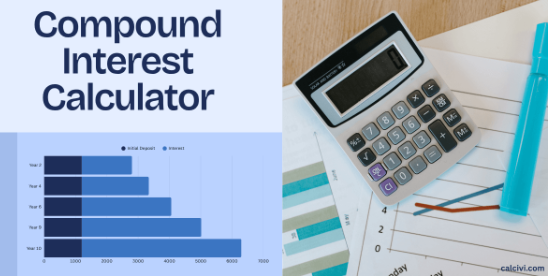
One of the key advantages of using a compound interest calculator is its ability to visually demonstrate the growth of your investment. Most calculators provide a graph that allows you to see how your money compounds over time. This feature makes it easier to grasp the concept of ‘earning interest on interest’, which can be a powerful motivator for saving and investing.
Decision Making
Understanding how compounding works can significantly influence your financial decisions. For instance, when considering a personal loan, a compound interest calculator can help you understand how the total amount you’ll pay back changes depending on the interest rate and loan duration.
Strategic Planning
Planning for long-term financial goals, such as retirement, education, or a down payment on a house, can be enhanced by understanding how your investments will compound. A compound interest calculator can help you set realistic savings goals and timelines.
Compound Interest in Personal Loans
While the benefits of compound interest are often highlighted in the context of investments, it’s equally important to consider its role in borrowed money. With personal loans, interest can be compounded, which may lead to a higher total repayment amount than initially expected.
Understanding Loan Terms
When you take out a personal loan, the lender will typically specify the interest rate and compounding method. It’s crucial to understand how these terms will affect the total repayment. A compound interest calculator can help you ascertain:
- Total Amount Repayable: See how much you will pay in total at the end of the loan term.
- Monthly Payment: Understand how much each payment will be if you opt for a structured repayment plan.
- Comparison of Loan Offers: Different lenders may offer different rates and terms; using a calculator can help you make comparisons.
Strategies for Maximizing Compound Interest
Start Early
The earlier you start investing, the more significant impact compound interest will have on your wealth. Even small contributions can grow substantially over time.
Reinvest the Earnings
If possible, reinvest any earnings instead of cashing them out. By allowing your interest to accumulate and compound, you can maximize your returns.
Diversify Investments
Different investment vehicles compound at different rates. By diversifying your investments, you can take advantage of varying compounding effects across accounts.
Conclusion
A compound interest calculator is a fundamental financial tool that can show you how your money grows over time. By understanding and utilizing this calculator, you gain valuable insights into your investment strategies and personal loans, enabling smarter financial decisions. Whether you are looking to invest for the future or take out a personal loan, recognizing how compound interest works can empower you to optimize your financial health. Understanding this concept can motivate you to save and invest wisely, ensuring your money works for you. Use these insights to take charge of your financial journey!