
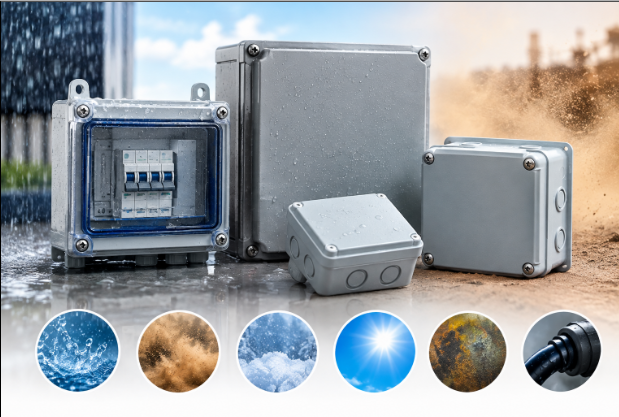
Electrical equipment is frequently installed in locations with different levels of environmental exposure. A control cabinet inside a clean office has different protection needs from equipment positioned near industrial machinery, outdoor utility connections, or areas exposed to regular water spray. Selecting an enclosure therefore requires more than considering its dimensions and material. Understanding NEMA enclosures types helps engineers, electricians, and facility managers identify the environmental conditions an enclosure is designed to withstand and select suitable protection for their installations.
What Do NEMA Enclosure Ratings Mean?
The National Electrical Manufacturers Association (NEMA) establishes standards that describe the protective characteristics of electrical enclosures.
ANSI/NEMA 250 covers enclosures for electrical equipment rated at 1,000 volts or less. Its classifications address protection against access to hazardous components, solid foreign objects, water exposure, corrosion, and other environmental conditions.
A NEMA enclosures types is how an enclosure is designed and tested. It should not be interpreted as a general guarantee that the equipment will withstand every possible environmental hazard.
Why Are These Ratings Important?
An unsuitable enclosure can expose electrical components to moisture, dust, corrosion, or physical damage.
For example, a cabinet intended for a dry indoor location may not provide sufficient protection when installed outdoors. Similarly, an enclosure exposed to corrosive cleaning chemicals may require additional material protection.
Understanding nema enclosures types allows professionals to compare protective characteristics before selecting a cabinet.
Common NEMA Enclosure Classifications
Each classification addresses specific environmental conditions. The following types are commonly encountered in industrial and commercial installations.
1. Type 1: General-Purpose Indoor Protection
Type 1 enclosures are designed primarily for indoor applications where protection against accidental contact with enclosed equipment and falling dirt is required.
They are commonly used for electrical panels, control components, and other equipment installed in relatively clean indoor environments.
These enclosures are not intended to provide protection against water exposure or significant dust accumulation.
2. Type 3R: Outdoor Rain Protection
Type 3R enclosures are designed for outdoor applications where protection against falling rain, sleet, and external ice formation is important.
They are frequently used for electrical distribution equipment and outdoor wiring installations.
However, Type 3R should not be confused with Type 4. Its protective characteristics do not include the same level of protection against hose-directed water or windblown dust.
3. Type 4: Water and Dust Protection
Type 4 enclosures are suitable for indoor or outdoor applications involving windblown dust, rain, splashing water, and hose-directed water.
They are useful in industrial facilities where equipment may be exposed to routine washdown activities.
Their construction must maintain the required protective performance when installed according to the manufacturer’s instructions.
4. Type 4X: Additional Corrosion Resistance
Type 4X provides the protective characteristics of Type 4 with additional corrosion resistance.
These enclosures may be appropriate for coastal installations, food-processing facilities, chemical environments, and other locations where corrosive exposure is a concern.
Material selection remains important. Stainless steel and other suitable corrosion-resistant materials may be considered depending on the environmental conditions.
5. Type 12: Industrial Indoor Protection
Type 12 enclosures are primarily intended for indoor industrial applications.
They provide protection against circulating dust, falling dirt, fibers, lint, dripping water, light splashing, and certain forms of external condensation.
They are commonly considered for manufacturing equipment, electrical control panels, and machinery installations where these conditions are present.
How to Compare Different Enclosure Types
Understanding nema enclosures types becomes easier when their intended applications are compared rather than treating the classifications as a simple numerical ranking.
| NEMA Type | Typical Application | Main Protection |
| Type 1 | General indoor areas | Accidental contact and falling dirt |
| Type 3R | Outdoor installations | Falling rain, sleet, and external ice |
| Type 4 | Indoor and outdoor | Dust, rain, splashing, and hose-directed water |
| Type 4X | Corrosive environments | Type 4 protection plus corrosion resistance |
| Type 12 | Industrial indoor settings | Dust, dirt, dripping, and light splashing |
A higher numerical designation does not automatically mean that an enclosure provides better protection in every category. The relevant environmental characteristics must guide the decision.
Factors to Consider Before Selecting a Rating
Environmental Exposure
Start by identifying where the enclosure will be installed. Consider rainfall, humidity, dust, water spray, cleaning procedures, chemical exposure, and temperature changes.
An indoor production facility may need a different rating from an outdoor electrical installation near a coastline.
Equipment Requirements
The enclosed equipment also influences selection. Electrical panels, terminal assemblies, control systems, and power distribution components may have different operating and installation needs.
Review the equipment manufacturer’s recommendations before finalizing the enclosure specification.
Material and Construction
The enclosure material should be compatible with the surrounding environment.
Mild steel may be suitable for many general industrial applications, while galvanized steel, aluminum, and stainless steel may offer advantages under particular exposure conditions.
Gaskets, door construction, hinges, fasteners, and cable entry fittings must also be considered.
Installation and Maintenance
A correctly rated enclosure can lose its intended protective performance if it is improperly installed.
Cable openings, conduit connections, mounting orientation, damaged seals, and modifications can affect the finished assembly. Maintenance personnel should inspect these areas periodically.
NEMA Ratings and IP Ratings Are Not Interchangeable
NEMA and IEC 60529 use different classification systems.
IP ratings primarily describe protection against solid object and water ingress. NEMA classifications consider additional characteristics, including corrosion resistance, icing effects, and certain construction details.
Consequently, an IP rating should not automatically be treated as equivalent to a particular NEMA designation. Any comparison must consider the actual testing criteria and installation conditions.
Common Mistakes When Choosing an Enclosure
Several selection errors can reduce protection or increase unnecessary costs:
- Selecting an indoor rating for an exposed outdoor location.
- Ignoring corrosion when equipment is installed near chemicals or saltwater.
- Assuming all water-resistant ratings provide equivalent protection.
- Overlooking cable entry and sealing arrangements.
- Choosing a material without considering long-term exposure.
- Treating a component rating as proof that the complete installation meets the same standard.
A proper environmental assessment helps avoid these problems.
Conclusion
Enclosure selection should be based on the specific conditions surrounding an electrical installation, including moisture, dust, corrosion, equipment requirements, and maintenance needs. Understanding the differences between the various classifications helps professionals specify appropriate protection without relying on assumptions. Reviewing the characteristics of different NEMA enclosures alongside installation and material requirements supports more dependable electrical system design.