

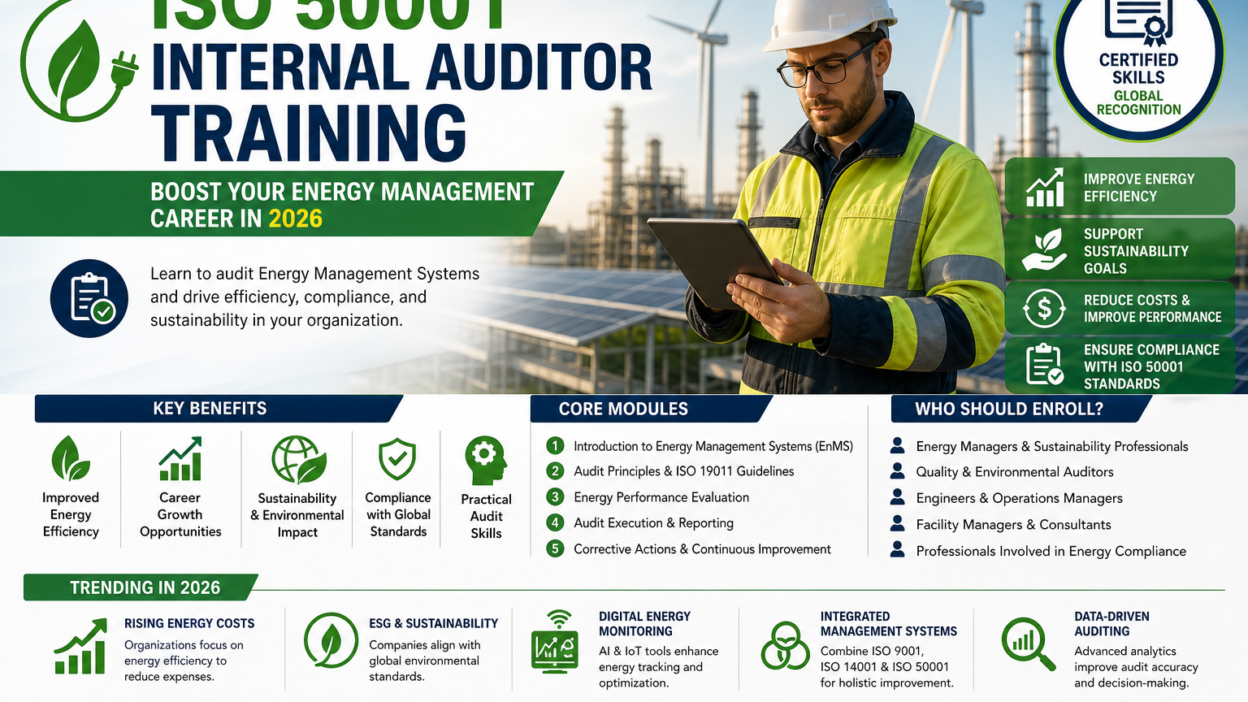
Managing energy use effectively takes more than tracking utility bills. Organizations that consistently reduce energy consumption usually have a structured energy management system and trained people who can verify whether it works. This is where ISO 50001 internal auditor training becomes valuable.
For energy and facilities managers, developing internal auditing skills means the organization can conduct reviews more frequently with less disruption to daily operations. Internal capability also reduces dependence on external reviewers when teams need to monitor energy performance throughout the year rather than only before an external assessment.
Common Challenges New Auditors Face
New internal auditors often find it difficult to separate their daily operational responsibilities from their auditing role. This can make it harder to identify issues in areas they manage themselves. Maintaining objectivity is therefore an important part of becoming an effective internal auditor.
Understanding energy data can also present an early challenge. Auditors need enough technical knowledge to recognize unusual readings, inconsistent measurements, or unexpected performance trends. They should not simply accept every reported figure without checking whether the information is reliable and appropriate.
Writing clear and specific findings also requires practice. A statement such as “improve monitoring” gives management very little direction. A stronger finding explains what the auditor observed, which requirement or process is affected, and why the issue needs attention.
What ISO 50001 Focuses On
ISO 50001 is an international standard for energy management systems. It provides a structured approach for organizations to plan, monitor, measure, and improve their energy performance over time.
The standard requires organizations to establish energy baselines, define relevant energy performance indicators, set improvement objectives, and monitor performance using reliable information. These activities help organizations understand how they use energy and where improvements may be possible.
ISO 50001 Internal Auditor Training also encourages organizations to consider energy performance when making decisions about equipment, facility design, processes, and other relevant changes. This prevents energy management from becoming an isolated activity and connects it with everyday operational and investment decisions.
What a Typical Internal Audit Looks Like
Reviewing Documentation
Internal auditors review energy policies, objectives, targets, action plans, procedures, and other relevant records. They check whether documentation remains current and whether it reflects actual practices within the organization.
The review should not stop at confirming that documents exist. Auditors need to compare documented processes with objective evidence from the workplace. This helps determine whether employees actually follow the established energy management processes.
Sampling Energy Data
Auditors generally sample energy records instead of checking every individual data point. Sampling allows them to assess whether monitoring, measurement, and reporting processes work consistently.
During this review, auditors may look for missing information, unusual values, inconsistent measurements, or gaps in data collection. Reliable energy data gives the organization a stronger basis for evaluating performance and identifying improvement opportunities.
Interviewing Relevant Staff
Speaking directly with employees involved in energy management can reveal information that documentation does not show. Auditors may ask how employees monitor energy use, respond to unusual consumption, follow operating procedures, or communicate energy-related issues.
These conversations help auditors determine whether employees understand their responsibilities and whether the organization’s energy management practices operate as documented.
The Role of an Internal Auditor
Verifying the System Works
Internal auditors determine whether energy management procedures work in practice rather than simply confirming that they appear in documented systems. They compare requirements, documented processes, records, observations, and employee responses to build an objective picture of system performance.
This approach helps organizations identify gaps before they become larger problems and gives management useful information for improving the energy management system.
Identifying Improvement Opportunities
Internal audits can identify more than nonconformities. Auditors may also notice inefficient practices, inconsistent monitoring, equipment-related concerns, or opportunities to improve energy performance.
A well-conducted audit therefore provides value beyond compliance. It can help management understand where the organization can improve its energy management practices and make better use of available resources.
Supporting Continuous Improvement
Regular internal audits create a feedback loop for the energy management system. Each audit provides information that teams can use to correct weaknesses, review existing controls, and improve future performance.
When organizations track findings over multiple audit cycles, they can also determine whether corrective actions produce lasting results or whether the same issues continue to appear.
What the Training Actually Covers
A typical training program introduces participants to the structure of an energy management system, relevant documentation, audit principles, audit planning, evidence collection, and reporting. Participants learn how to plan an audit that covers important areas without making the process unnecessarily time-consuming.
Completing structured ISO 50001 internal auditor training gives energy and facilities professionals greater confidence to conduct internal reviews independently. Instead of relying only on external assessments, trained employees can identify weaknesses throughout the year and support timely corrective action.
Practical exercises may include reviewing sample energy data, identifying potential nonconformities, evaluating evidence, conducting interview exercises, and documenting findings. These activities help participants understand how audit principles translate into real workplace situations.
Why Internal Audits Matter Between External Reviews
External assessments usually take place periodically. This creates a gap during which issues can develop without receiving attention. Internal audits help fill that gap by identifying problems while they remain relatively small and easier to address.
Regular internal reviews also help organizations remain prepared for future external assessments. Instead of rushing to correct problems when an external audit approaches, teams can identify and address weaknesses as part of their normal management activities.
For organizations operating several facilities, internal audits can provide another important advantage. Comparing findings and energy performance between sites may reveal useful patterns. For example, one facility may consistently perform better than another despite using similar equipment. This difference can encourage the organization to investigate processes, maintenance practices, or operating methods that could be applied elsewhere.
Building Internal Audit Capability Over Time
Organizations that train several internal auditors can often achieve more consistent and objective results. Auditors can rotate between departments and sites, reducing the risk of repeatedly auditing areas where they have direct operational responsibilities.
Refresher training also helps maintain audit capability as energy management practices develop. New equipment, changing processes, updated reporting expectations, and evolving energy objectives can all affect how audits should be performed.
Pairing new auditors with experienced colleagues during their first assignments can also accelerate practical learning. New auditors can observe how experienced professionals ask questions, evaluate evidence, handle difficult conversations, and document findings.
Connecting Internal Audits to Real Improvement
An internal audit has limited value if the final report simply gets filed away. Findings need a clear path to action. Organizations should assign responsible people, establish realistic deadlines, and monitor progress until corrective actions are properly addressed.
Tracking recurring findings across several audit cycles can provide even more useful information. If the same issue continues to appear, the organization may need to investigate its root cause instead of applying another temporary correction.
Sharing appropriate audit outcomes with employees can also strengthen the value of the process. When staff understand why audits happen and how findings contribute to improvement, they are more likely to see internal audits as a practical management activity rather than a documentation exercise.
Over successive audit cycles, this consistency can produce measurable benefits. Organizations may see more reliable energy performance data, fewer surprises during external assessments, stronger corrective actions, and faster identification of energy inefficiencies.
That cumulative improvement is one of the main reasons to develop internal audit capability. Instead of treating auditing as a compliance requirement, organizations can use it as a management tool that supports better energy performance.
Turning Audits Into an Energy-Saving Tool
Internal auditing is not simply a compliance formality. When organizations conduct audits effectively, they can identify inefficiencies before those issues become larger performance problems.
Organizations that invest in ISO 50001 internal auditor training can build a more responsive approach to energy management. Trained employees can monitor processes, question unusual results, verify controls, and communicate findings without waiting for an external reviewer.
This capability can become more valuable over time. Each audit cycle gives the team another opportunity to improve its understanding of energy performance and strengthen the way it identifies and addresses problems.
Ultimately, an organization that trains its own people to ask the right questions is better positioned to maintain and improve its energy management system. Internal auditors can identify weaknesses earlier, support corrective action, and help management make decisions based on reliable information.
Building this capability does not happen overnight. It develops through training, practical experience, regular reviews, and continuous learning. However, the investment can extend well beyond the next audit cycle by strengthening how confidently the organization manages energy performance for years to come.