

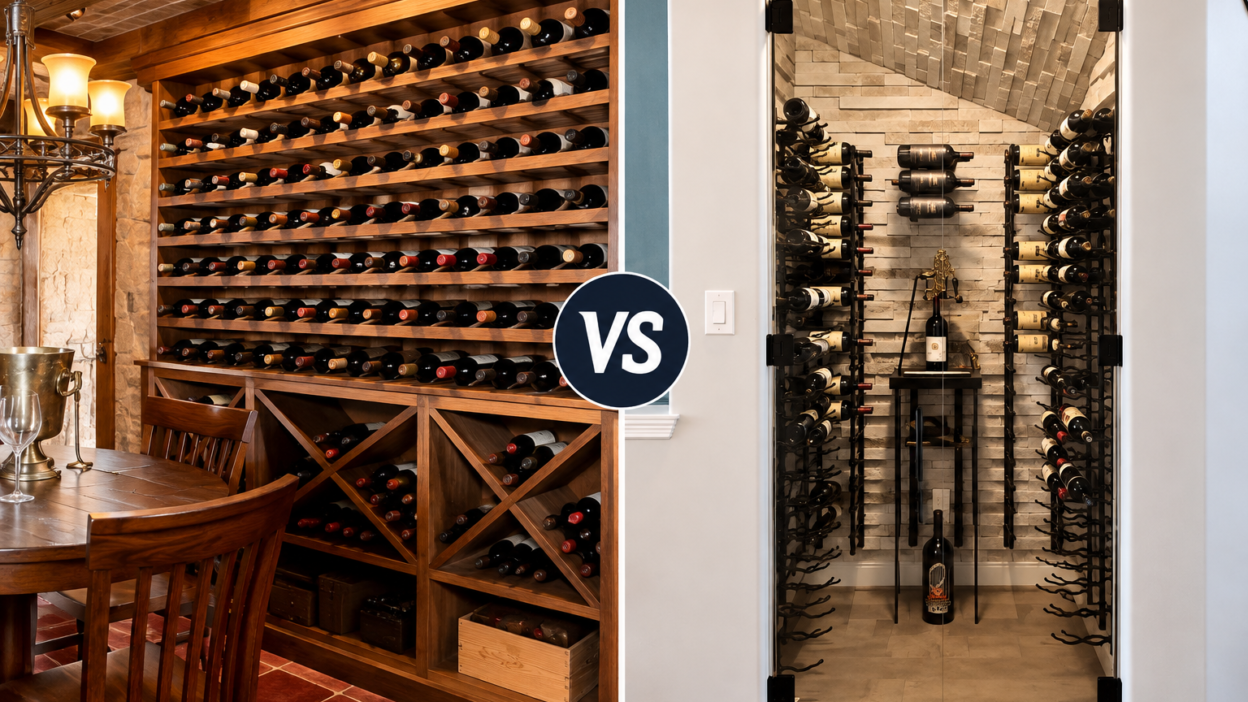
Did you just start building the wine collection you always wanted? Then, I’m sure you have an awkward question: should those beautiful bottles lie down or stand up? It sounds like a small detail, but when you’re storing wine for years, bottle position can matter. Understanding the horizontal vs. vertical wrought iron rack options can help you to choose the right storage solution for keeping your collection safe.
If you’re considering a wrought iron wine rack, the good news is that the material itself isn’t the deciding factor. What matters more is how the rack positions your bottles, what type of closure they have, and how well your cellar controls its environment. Let’s dive in.
Why Does Bottle Position Matter For Corks?
Let’s start with the cork. If your bottle has a natural cork closure and you plan to age it, horizontal storage is generally the safer choice.
When a bottle lies on its side, the wine stays in contact with the cork. This helps reduce the risk of the cork drying out. WSET recommends storing cork-sealed bottles on their sides for this reason.
The Australian Wine Research Institute (AWRI) also recommends storing cork-sealed wine lying down after the initial post-bottling period. Extended upright storage can allow corks to dry and become more susceptible to oxygen permeation.
So, if you’re aging that special Bordeaux for a few years, horizontal is usually your friend.
Horizontal vs Vertical Wine Storage
| Factor | Horizontal Storage | Vertical Storage |
| Natural cork | Best for long-term storage | Less suitable for extended aging |
| Screwcap | Works well | Works well |
| Space | Uses more wall depth | Can save space |
| Bottle access | Easy with proper racking | Convenient for short-term storage |
| Best use | Aging collections | Ready-to-drink bottles |
Vertical storage isn’t automatically wrong. Bottles with screwcaps, for example, can be stored upright. The key is knowing your collection.
Why Choose Wrought Iron?
Now we get to the fun part: the rack itself.
A well-designed wrought iron rack can give your cellar a striking architectural feel while securely supporting your bottles. It also works beautifully when you want your storage to feel more like part of the room than simple shelving.
That’s one reason luxury wine racks often combine strong materials with thoughtful design. Your rack needs to look good, but it also needs to fit the bottle sizes, wall space, and the way you use your collection.
For larger or unusual collections, custom wine racks can make more sense than an off-the-shelf option. Wine Cellars of Houston, for example, builds racks around collection size, available space, and design preferences rather than treating every cellar the same.
What About Wood Wine Racks?
Wrought iron isn’t your only option. Custom wood wine racks remain popular in Texas City and Richmond because wood brings warmth and a classic cellar character.
Wood and iron can also work together. Think sturdy metal framing with wooden components, or wrought iron used as a visual feature alongside traditional racking. The right choice depends on your cellar’s architecture and the look you want.
In other words, don’t choose a rack simply because it looks impressive in someone else’s home wine cellar. Your collection and your space should drive the decision.
Don’t Forget Temperature and Humidity
Here’s the part I would never overlook: the rack cannot protect wine from a bad cellar environment.
Temperature swings, excessive heat, dryness, and light can all affect wine as it ages. AWRI notes that prolonged temperatures above 25°C can affect wine quality, while humidity also matters for natural closures.
A properly designed cellar should therefore consider insulation, cooling, humidity, and ventilation alongside racking. This is particularly important when planning custom wine storage in a warm climate such as Dallas or Austin.
In hot regions, cellar design must prioritize:
- Insulation
- Vapor barriers
- Reliable cooling systems to maintain a stable environment year-round
Even small fluctuations in temperature or humidity can accelerate wine aging and compromise long-term quality. For serious collectors, investing in proper climate control and professionally designed racking ensures that both the structure and the storage conditions work together to protect the collection.
If you’re planning long-term storage for natural-cork bottles, I’d choose horizontal wrought iron storage. It keeps the bottles in the traditional aging position while giving you the durability and visual impact of metal.
If you mostly drink younger wines, use screwcaps, or need vertical display space, upright storage can be perfectly practical.
And if you’re researching wine cellars in Houston, don’t stop at the question of horizontal versus vertical. Look at bottle closures, collection size, cellar conditions, rack construction, and future expansion.
The best wine rack is the one designed around how you actually collect, store, and enjoy wine.